Bike Noob

Because I'm Always Learning Something New

  • Home
  • About
  • Contact
  • Partners

Some Bike-Related Reading

09.20.2012 by Ray Niekamp // 2 Comments

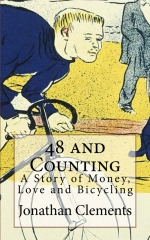
Author Jonathan Clements has penned a novel about biking. Well, it’s about money management. Uh…it’s really about a guy’s midlife crisis, with a healthy dose of money management and biking thrown in.

The book is “48 and Counting: A Story of Money, Love and Bicycling.” Clements is a former writer for the Wall Street Journal, who has since moved on, but he’s still writing — and riding. He recounts the story of Max Whitfield, a 48-year-old money manager, who discovers the joy of bike riding. As Max gets more involved in his new pastime, he springs for an expensive road bike, decks himself out in fancy lycra kit, and joins a local club ride, where he is promptly spit out the back. But he keeps coming back, and keeps getting faster.

However, while Max is wrapped up in cycling, he’s neglecting his business. His ambitious assistant plots to grab it. He’s also neglecting his marriage, and a woman he meets by chance starts looking mighty fine. When his life implodes, Max decides to set a new goal for himself. He enters a 40-mile road race.

Although Clements has been a financial journalist, with four earlier books about money, this is his first novel. He had always thought he’d write a novel once he retired, but when his father died after being hit by a car while cycling, Clements decided he’d better write the novel now — because he might not make it to retirement.

His love of cycling is evident throughout the book. Clements rides his road bike in New York City, often near his home on Roosevelt Island. “Down the south end of the island, I have what I consider my personal criterium course,” he said in an email to me. “It’s 0.9 mile around, with a few stop signs you can safely ignore. During the week, I’ll bang out a quick 13 or 14 miles there, going round and round like a crazed rat on a treadmill, and judge the ride by which side of 20 mph I average.”

The weekends find him in Central Park, where cars aren’t allowed on the main six-mile circuit on Saturdays and Sundays. “Again, averaging at least 20 mph is my goal, but that’s much easier in the park because the roads are smoother, there are fewer tight turns and – at the weekend — my aging body has a little longer to wake up before I hit the road,” he told me.

Making the switch from financial columnist to novelist was tougher than Clements thought. “I’ve spent my entire writing career telling people, in simple, plain English, what to do with their money,” he said. “But with ’48 and Counting,’ I wasn’t doling out advice, but telling a story. Making the switch proved surprisingly difficult.”

He pulled it off, though. It’s an entertaining story, one that can be read in one evening, and some of the cycling scenes — the clipless fall, the arrogant hammerheads on the club ride — will be familiar to many. “48 and Counting” is available as a $9.99 paperback through Amazon and as a $3.99 Kindle and Nook e-book. With the onset of autumn, and less genial cycling weather for many of us, some time with the book could be a satisfying substitute for time in the saddle.

Like this:

Like Loading...

Categories // Books Tags // book review

Summer Bike Reading

07.21.2011 by Ray Niekamp // 8 Comments

I’m an avid reader, and I try to vary my reading enough that I’m not a single-subject guy. History and mysteries are favorites. But every once and a while, I have to indulge my biking side and tackle a book written by (but not necessarily for) cyclists.

So when I was offered the opportunity to read “It’s All About the Bike” by Robert Penn (New York: Bloomsbury, $20), I jumped at it.

It’s a very simple premise: The writer, a resident of Wales, has been an avid biker for most of his life. He pedaled around the world when in his twenties. But now, he’s after his dream bike — the one bike that will last him the rest of his life. And to get it, he’s having components manufactured by the best at their crafts — wherever they might be.

For Penn, the bike of his life will be a racing-style bike, but he’ll ride it for everything — commuting, long distance rides on the weekends, even longer trips to cycling’s storied routes. He won’t settle for humdrum materials like carbon fiber. His frame must be custom built. He picks a lightweight steel frame hand built by Rourke in England. He travels to the United States for a headset from Chris King and wheels from Steve Gravenites (“Gravy”), then to Italy for a drive train from Campagnolo (Record). Back to England to see his Brooks B-17 saddle made at the Brooks plant, much the same as they’ve been made since 1896.

But something happens as Penn travels the globe to build his bike: He delves into the history of cycling and the components that make the bike what it is today. The reader is introduced to Baron Karl von Drais de Sauerbronn, the inventor of the “Draisine.” That was the first machine that looked something like the bike of today, even if the rider had to push it over the ground with his feet. And James Starley, who came up with the idea for tangent-spoked wheels, the kind we still ride on today. We learn how Tullio Campagnolo invented the derailleur. And at the end of it all, the reader understands just how much goes into the creation of a bicycle, and where it all came from, and how it all evolved.

For that reason, non-bikers might enjoy the book, too. Penn is a journalist who writes for a variety of different publications, and his writing is erudite but accessible. The book is relatively short — 186 pages — and most people will get through it in just a couple of nights. It got me thinking about what my ultimate bike might look like. I was left with one minor disappointment though. There’s no picture of the finished bike. Readers will have to conjure that up on their own.

Like this:

Like Loading...

Categories // Books, Review Tags // book review

Book Review: New Cyclist Handbook

04.23.2008 by Ray Niekamp // 2 Comments

Since the purpose of this blog is to share my experiences as I get into cycling, with the hope that others new to the sport might get something out of them, I thought it might be worthwhile to take a look at some books targeted at the newbie cyclist. I only have a few on my bookshelf — most of what I know about cycling I learned from the fine posters to Bike Forums and other biking blogs — but I’ll briefly review the ones I have and add reviews to other books as those books come to my attention.

The first in this series of reviews is Bicycling Magazines’ New Cyclist Handbook, edited by Ben Hewitt, Rodale Press, 2005. It’s an update of an earlier version that came out in 2000. Why a three-year-old book? It’s widely available in bookstores, and is likely to be a candidate for selection by a new rider looking for fast info. That’s how I wound up with it.

The Table of Contents indicates that the book will address major issues faced by new cyclists. The book is broken up into six parts: The Bike, The Body, Skills & Techniques, Getting Good (training), Body Care, and Bicycle Care. The chapters within those parts deal with specific topics in a bit more detail. Not exhaustive detail, because many of the chapters seem to be adapted from — or are outright reprints from — articles that have appeared over the years in Bicycling Magazine. Editor Hewitt suggests in the Introduction that the reader take a look at only one or two chapters at a time, and let them sink in while going for a ride.

I found some of the chapters to be worth revisiting several times. The “Getting Good” part has a chapter called “Instant Improvement” — little things a cyclist can do to become more efficient. “Training for a Century” has two versions of a training plan: One for those who just want to survive the 100 miles, and another for those who want to thrive on it. Other chapters were too elementary to spend any real time with, such as “Choose the Right Bike” — it’s likely the reader already has a bike, and just wants to get better riding it — and “Clothing and Accessories” (mostly accessories).

In today’s Internet age, everything in this book can be found online, usually in better detail. Much of it can be found on Bicycling’s own excellent web site, Bicycling.com. In fact, if you visit their home page today, you’ll find links to articles on Ten Cycling Tips Every Cyclist Needs to Know, Bike Buying Tips, and Training Tips — the same kinds of info in the book.

So why even bother buying the book? For me, sometimes having a reference in my hands is important. I’m of a generation that likes to sit back in an easy chair and read, rather than hunch over a computer keyboard and search. For that reason alone, the New Cyclist Handbook could be a useful addition to your bookshelf.

Like this:

Like Loading...

Categories // Books

Get Email Updates

Enter your email address to subscribe to this blog and receive notifications of new posts by email.

Join 257 other subscribers

Categories

  • Accessories
  • Bike fit
  • Bikes
  • Blogging
  • Books
  • clubs
  • Cold weather
  • Community
  • Commuting
  • Components
  • crash
  • cycling
  • Equipment
  • Favorite rides
  • fitness
  • food
  • guest post
  • Heat
  • Injury
  • logs
  • Maintenance
  • Mental
  • Nutrition
  • Odds 'n ends
  • People
  • Poll
  • Racing
  • Records & stats
  • Review
  • Rides
  • running
  • Safety
  • soreness
  • Specialized
  • Technique
  • Technology
  • Tips
  • tires
  • training
  • Travel
  • Uncategorized
  • Home
  • About
  • Contact
  • Partners

Recent Posts

  • Getting Back on the Bike: Road Cycling Tips for Older Cyclists
  • Are BCAAs and EAAs Good for Cycling?
  • How to Fix Numb Toes When Cycling
  • How to Find and Vet a Bike Club
  • Celebrate Pearl Izumi with Big Savings in the Memorial Day Sale

Categories

  • Accessories
  • Bike fit
  • Bikes
  • Blogging
  • Books
  • clubs
  • Cold weather
  • Community
  • Commuting
  • Components
  • crash
  • cycling
  • Equipment
  • Favorite rides
  • fitness
  • food
  • guest post
  • Heat
  • Injury
  • logs
  • Maintenance
  • Mental
  • Nutrition
  • Odds 'n ends
  • People
  • Poll
  • Racing
  • Records & stats
  • Review
  • Rides
  • running
  • Safety
  • soreness
  • Specialized
  • Technique
  • Technology
  • Tips
  • tires
  • training
  • Travel
  • Uncategorized

Archives

  • May 2024
  • December 2023
  • November 2023
  • March 2022
  • October 2020
  • November 2018
  • May 2018
  • September 2017
  • November 2016
  • October 2016
  • January 2016
  • July 2015
  • June 2015
  • May 2015
  • April 2015
  • March 2015
  • February 2015
  • January 2015
  • December 2014
  • November 2014
  • October 2014
  • September 2014
  • August 2014
  • July 2014
  • June 2014
  • May 2014
  • April 2014
  • March 2014
  • February 2014
  • January 2014
  • December 2013
  • November 2013
  • October 2013
  • September 2013
  • August 2013
  • July 2013
  • June 2013
  • May 2013
  • April 2013
  • March 2013
  • February 2013
  • January 2013
  • December 2012
  • November 2012
  • October 2012
  • September 2012
  • August 2012
  • July 2012
  • June 2012
  • May 2012
  • April 2012
  • March 2012
  • February 2012
  • January 2012
  • December 2011
  • November 2011
  • October 2011
  • September 2011
  • August 2011
  • July 2011
  • June 2011
  • May 2011
  • April 2011
  • March 2011
  • February 2011
  • January 2011
  • December 2010
  • November 2010
  • October 2010
  • September 2010
  • August 2010
  • July 2010
  • June 2010
  • May 2010
  • April 2010
  • March 2010
  • February 2010
  • January 2010
  • December 2009
  • November 2009
  • October 2009
  • September 2009
  • August 2009
  • July 2009
  • June 2009
  • May 2009
  • April 2009
  • March 2009
  • February 2009
  • January 2009
  • December 2008
  • November 2008
  • October 2008
  • September 2008
  • August 2008
  • July 2008
  • June 2008
  • May 2008
  • April 2008
  • March 2008
  • February 2008

Copyright © 2026 · Modern Studio Pro Theme on Genesis Framework · WordPress · Log in

Go to mobile version
%d