Bike Noob

Because I'm Always Learning Something New

  • Home
  • About
  • Contact
  • Partners

Saddles

03.17.2008 by Ray Niekamp // 8 Comments

Saddles are a sore point with most cyclists (pun intended). It seems to be an article of faith that upon purchasing a new bike, the first thing you do is get rid of the stock saddle, and put on something else.

Sadly, there’s no “best” saddle recommendation available. Since everybody is built differently, everybody has a saddle that is going to be the best fit for them. The problem is, how do you find it?

When my wife started training for her charity ride last year, her old saddle began falling apart. It was an Avocet gel saddle, and she liked it quite a bit. The local bike shop suggested the Specialized Dolce Gel to replace the Avocet, and despite what looked like an odd shape, my wife found that she liked it.

dolcegel.jpg

The Specialized Dolce Gel saddle.

Back when she had first put the Avocet on her Trek hybrid, I grabbed the Trek’s saddle for the Raleigh. It was a gel saddle, and I figured it would be more comfortable than the stock seat.

treksaddle.jpg

The Trek gel saddle.

I was right. For casual rides around town, and even some longer rides on asphalt “rails to trails” bike paths, it was fine. But on my 50-mile organized ride, it put me in agony with 15 miles to go. I went shopping for a new saddle right away.

Performance Bike, the online bike catalog store, has two brick-and-mortar stores in Austin. They carry a good variety of saddles, ranging in price from more than $200 to quite reasonable. The saddles with cutouts intrigued me. The cutout — to relieve pressure on sensitive areas of the bottom — seemed to make sense. I got the Forte Classic saddle. Forte is Performance’s house brand, and I assumed I was taking a risk of sorts, but the saddle won.

forteclassic.jpg

The Forte Classic.

But this one never really worked out. Although I rode it in the metric century, I was very uncomfortable during the last 10-15 miles. I had had the saddle for about a month at the time of the ride, and thought I would be accustomed to it by now. Didn’t happen. I was making plans to buy a new saddle when I bought the new bike instead.

The Specialized Allez Elite comes equipped with Specialized’s own Alias saddle. It’s part of the “body geometry” line of saddles, which come in different widths for different sized butts. The saddle is the firmest I’ve ever ridden. But firm doesn’t necessarily mean uncomfortable.

specializedalias.jpg

The Specialized Alias saddle.

The wings of the saddle hit my sit bones dead on. All I have to do to get comfortable is stand up on the pedals for a little while, or slide a little bit back or forward on the seat. That’s enough of a change to keep me feeling energized. The “Body Geometry” line of saddles has different width sizing, so the buyer can get a saddle that’s 155 mm across, 143 mm (the default, and the one I have), or a narrow 130 mm saddle. This was an eye-opening sensation. It caused me to rethink my attitude toward saddles — that they must be gel, or wide, or whatever. This saddle works. It’s the stock seat for this bike.

Don’t be afraid to try several different kinds of saddles before finding the one that fits you. And check with the store for their return policy. Maybe after riding on your new saddle for a little while, you might discover that it doesn’t feel so good 20 miles from home. Many bike shops will exchange saddles within a reasonable trial period. Others won’t. Ask.

Like this:

Like Loading…

Categories // Components, Equipment

A new bike

02.24.2008 by Ray Niekamp // 6 Comments

My wife and I had agreed that my birthday present this year would be a new bike. I was just getting tired of pushing around the heavy Raleigh. My problem, though, was to figure out just what kind of bike to get.

Carbon would be interesting. But carbon bikes start around $2,000, and I couldn’t make myself spend that kind of money on a bike. I’ve been at it for less than a year, and what if I fall out of love with biking, and give it up in six more months?

Do I look at components, and go for the best I can buy within my budget? That’s not a bad idea, but it soon became clear that for $1,500 or less, which was my self-imposed price point, I’d be getting Shimano 105 derailleurs and shifters – the middle ground of Shimano’s line.

How about geometry? I’m in my 50s, and the old Raleigh stretched me out more than I wanted. The new, more upright geometry with sloping top tubes – “compact geometry” – might be the way to go.

Then there’s fit. Much of the information I’ve seen over the past several months argues that all those other things really don’t matter if the bike is a bad fit. It was also obvious that on my budget, I could get a lot more bike if I bought it online, from one of several companies that offer great deals. I’d have to do a small amount of assembly work myself, but I’d get a heckuva bike for the price. But I’m all thumbs, and those who advised to get a bike from a local bike shop (LBS) made sense. You pay a premium for service, fitting, and free tuneups for a year, but it’s worth it.

Okay. LBS, compact geometry, $1,500 limit. What to buy? My first target was the Specialized Roubaix, which has gotten a lot of good press since its introduction some years ago. But they started at about $1,600, and with the extras I planned to get, that just wouldn’t work. Specialized has a more entry-level road bike, the Allez, with basic components like Shimano Sora. Jamis and Felt offer bikes that have a nice combination of components at a decent price. Trek has two models that interested me – the Pilot, which is all about upright geometry, and the 2.3 – also featuring a compact frame, but with more emphasis on speed than comfort.

Bicycle Sport Shop in Austin stocks both Specialized and Trek. But it turns out they’ve dropped Trek’s aluminum frames, and only handle carbon. The choice, then, was easy.

allez1.jpg

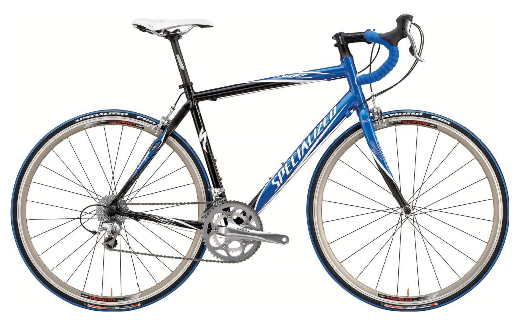
I picked the Specialized Allez Elite. Shimano 105 rear derailleur, Tiagra front. Compact crank, with 50 and 34 tooth sprockets. Compared to the Raleigh, light as a feather. Some of the other components are low end. I added two water bottle cages, a seat bag, and Shimano SPD-SL clipless pedals. The salesperson agreed to swap out the standard white saddle for a black one at no extra charge. Once the shop had mounted all the accessories, it was time to be fitted.

She put the bike on a trainer, and had me put on my bike shoes and get on. Once I started pedaling, she looked at my riding angle and leg extension. I stopped, and she held up a large clear plastic angle finder to my leg. We were trying to get a 35-degree bend in my leg at the bottom of the pedal stroke. She raised the seat a bit. I pedaled some more. She had me stop with the pedals at nine o’clock and three o’clock, and dropped a plumb bob from my forward knee. “This bike was made for you,” she said – no changes necessary there.

I got the bike home, changed into my cycling clothes, and took it out to the Veloway for a shakedown cruise. Verdict: I’m going to like this bike.

Like this:

Like Loading…

Categories // Bikes, Components, Specialized

Clipless pedals

02.21.2008 by Ray Niekamp // 9 Comments

As I mentioned earlier, one of the bike upgrades my wife made on the advice of her training buddies was to go to clipless pedals. (It’s an unfortunate name, since you wear a special cleat on the sole of your bike shoe that clips into the pedal – but it’s called “clipless” because it is not one of those old-fashioned toe clips that attaches to regular platform pedals.)

After her first ride with the clipless, she raved about her ability to add power to her pedal stroke by pulling up as well as pushing down. Less happy for her was the nagging feeling that she’s permanently attached to the bike. When riding, she’ll try to time upcoming stoplights so she doesn’t have to disengage her cleat at the corner. Instead, she’ll slowly ride up to the light and try to hit it just as it turns green. When she gets home, she pulls the bike onto our lawn to stop and disengage, so that if she falls, she’ll hit soft grass instead of hard concrete.

I was persuaded by her experience that clipless was a necessary addition to my bike. I bought a set from Nashbar, the large online bike shop. They have their own branded pedals, which are cheaper than all others I’ve come across. I had them installed at a local bike shop when the bike was in for other servicing, attached the cleats to my new bike shoes (Exustars – a relatively cheap Chinese brand also sold by Nashbar), and went out to practice. After clipping in and out on both left and right pedals (there – I used “clipping” while talking about “clipless” pedals. It’s awfully hard not to) I went out for a ride on the Veloway – a 3-mile paved bikeway about 3 miles away from my house. They were terrific. I instantly felt that additional pulling power on the upstroke. I can’t prove it, but it felt like I was going faster than usual. I returned home feeling good about the purchase.

pedal-2.png pedal-1.png

Two views of the clipless pedals on my bike.

Then, I turned into my driveway, slowed, tried to disengage – and did the famous “clipless fall.” That’s what happens when you don’t twist your heel out to the side firmly enough, and the cleat doesn’t come loose from the pedal. Still attached to the bike with both feet, you feel yourself slowly tipping over, past the point of recovering your balance, and wind up on your side on the driveway, still straddling the bike. By then, the cleat has come out of the pedal. Swell. On the plus side, since your speed is zero, the road rash (or “driveway rash”) is not as severe as if you fell out on the road.

Since then, I’ve had only one more clipless fall, (edit: make that two) and have learned that it’s a rite of passage all new clipless riders have to go through. I guess with only two to my name, I’m doing better than a lot of cyclists. I’ve become more adept at disengaging, and am diligent about doing it as I approach stoplights. My remaining clipless problem has to do with clipping back in once I get the green light. I can never seem to get the pedal in the right position. As the picture shows, its normal resting position is with the rear down, toe up. The trick is to guide your toe over the pedal, which pushes it forward, and allows the cleat to click in. it’s a trick that takes practice, and I’m still not good at it. As one biking acquaintance said, “Practice, practice, practice.”

Like this:

Like Loading…

Categories // Bikes, Components

  • « Previous Page
  • 1
  • …
  • 6
  • 7
  • 8

Get Email Updates

Enter your email address to subscribe to this blog and receive notifications of new posts by email.

Join 257 other subscribers

Categories

  • Accessories
  • Bike fit
  • Bikes
  • Blogging
  • Books
  • clubs
  • Cold weather
  • Community
  • Commuting
  • Components
  • crash
  • cycling
  • Equipment
  • Favorite rides
  • fitness
  • food
  • guest post
  • Heat
  • Injury
  • logs
  • Maintenance
  • Mental
  • Nutrition
  • Odds 'n ends
  • People
  • Poll
  • Racing
  • Records & stats
  • Review
  • Rides
  • running
  • Safety
  • soreness
  • Specialized
  • Technique
  • Technology
  • Tips
  • tires
  • training
  • Travel
  • Uncategorized
  • Home
  • About
  • Contact
  • Partners

Recent Posts

  • Getting Back on the Bike: Road Cycling Tips for Older Cyclists
  • Are BCAAs and EAAs Good for Cycling?
  • How to Fix Numb Toes When Cycling
  • How to Find and Vet a Bike Club
  • Celebrate Pearl Izumi with Big Savings in the Memorial Day Sale

Categories

  • Accessories
  • Bike fit
  • Bikes
  • Blogging
  • Books
  • clubs
  • Cold weather
  • Community
  • Commuting
  • Components
  • crash
  • cycling
  • Equipment
  • Favorite rides
  • fitness
  • food
  • guest post
  • Heat
  • Injury
  • logs
  • Maintenance
  • Mental
  • Nutrition
  • Odds 'n ends
  • People
  • Poll
  • Racing
  • Records & stats
  • Review
  • Rides
  • running
  • Safety
  • soreness
  • Specialized
  • Technique
  • Technology
  • Tips
  • tires
  • training
  • Travel
  • Uncategorized

Archives

  • May 2024
  • December 2023
  • November 2023
  • March 2022
  • October 2020
  • November 2018
  • May 2018
  • September 2017
  • November 2016
  • October 2016
  • January 2016
  • July 2015
  • June 2015
  • May 2015
  • April 2015
  • March 2015
  • February 2015
  • January 2015
  • December 2014
  • November 2014
  • October 2014
  • September 2014
  • August 2014
  • July 2014
  • June 2014
  • May 2014
  • April 2014
  • March 2014
  • February 2014
  • January 2014
  • December 2013
  • November 2013
  • October 2013
  • September 2013
  • August 2013
  • July 2013
  • June 2013
  • May 2013
  • April 2013
  • March 2013
  • February 2013
  • January 2013
  • December 2012
  • November 2012
  • October 2012
  • September 2012
  • August 2012
  • July 2012
  • June 2012
  • May 2012
  • April 2012
  • March 2012
  • February 2012
  • January 2012
  • December 2011
  • November 2011
  • October 2011
  • September 2011
  • August 2011
  • July 2011
  • June 2011
  • May 2011
  • April 2011
  • March 2011
  • February 2011
  • January 2011
  • December 2010
  • November 2010
  • October 2010
  • September 2010
  • August 2010
  • July 2010
  • June 2010
  • May 2010
  • April 2010
  • March 2010
  • February 2010
  • January 2010
  • December 2009
  • November 2009
  • October 2009
  • September 2009
  • August 2009
  • July 2009
  • June 2009
  • May 2009
  • April 2009
  • March 2009
  • February 2009
  • January 2009
  • December 2008
  • November 2008
  • October 2008
  • September 2008
  • August 2008
  • July 2008
  • June 2008
  • May 2008
  • April 2008
  • March 2008
  • February 2008

Copyright © 2026 · Modern Studio Pro Theme on Genesis Framework · WordPress · Log in

Go to mobile version
%d